A purchasing manager orders a four-bend terminal on a progressive die because the die shop quotes $28,000 for the tool — three weeks before SOP, the cam-actuated forming station jams at 120 SPM and throughput collapses to 40% of plan. The multi-slide machine would have produced the same terminal at 180 SPM with zero cam stations, but the tool steel is already cut and the delivery window is closed.
In this comparison, you will learn the per-part cost crossover between progressive die and multi-slide forming, the throughput boundaries defined by bend complexity, and the geometry flags that signal when multi-slide eliminates secondary operations.
Read on for the full decision framework.
Specification Matrix
Progressive die stamping and multi-slide forming are both high-speed metal forming processes, but they diverge fundamentally in how they deliver force to the workpiece. A progressive die applies force from a single vertical axis —the press ram —with all forming, piercing, and blanking operations sequenced along the strip feed direction. A multi-slide machine applies force from four independent axes —front, rear, left, and right —with forming tools converging on the workpiece simultaneously.
This architectural difference ripples through every downstream variable: tooling cost, throughput, geometry capability, and per-part economics for custom metal terminals.
| Parameter | Progressive Die Stamping | Multi-Slide Forming |
|---|---|---|
| Force Architecture | Single-axis vertical ram; sequential stations along strip feed direction | Four independent horizontal slides converging on a central forming post |
| Tooling Investment | $15,000—50,000 for a full progressive die set | $8,000—25,000 for slide tooling and cam sets |
| Tooling Lead Time | 4— weeks for die build and tryout | 2— weeks for slide tooling fabrication |
| Cycle Speed | 200—,200 SPM on high-speed presses | 60—50 cycles per minute (each cycle completes a part) |
| Material Thickness Range | 0.08—.0 mm for precision terminal strip | 0.10—.5 mm; optimal below 1.0 mm |
| Bend Plane Capability | Single-plane (2D) standard; multi-plane via cam-actuated forming stations | Multi-plane (3D) in a single machine cycle; four simultaneous bend axes |
| Tolerance Capability | ±0.01—.05 mm on critical features | ±0.03—.10 mm; wider due to sequential slide timing variation |
| In-Die Operations | Piercing, blanking, coining, embossing, threading, staking, in-die tapping | Forming, bending, coining, limited piercing; no in-die tapping or staking |
| Material Utilization | 70—5% with optimized strip layout; skeleton scrap recyclable | 80—2%; narrower carrier or wire-fed stock reduces waste |
| Plating Readiness | Reel-to-reel selective plating integrated downstream; parts remain on carrier strip | Bulk or loose-piece plating after forming; higher handling cost for stamped electrical contacts |
| Volume Sweet Spot | Above 50,000 annual units; tooling amortization at scale | 5,000—00,000 annual units; complex geometry at moderate volume |
The numbers reveal a clear split: progressive dies deliver the lowest per-part cost and highest throughput for electrical stamping components with predominantly planar geometry, while multi-slide machines eliminate secondary bending costs for terminals with complex multi-plane geometries. The following sections unpack the decision logic in detail.
When Progressive Die Stamping Wins
Planar Geometries at High Volume
Progressive die stamping owns the cost curve when terminal geometry is predominantly planar —bends confined to a single plane, features arrayed along the strip feed direction —and annual volumes exceed 50,000 units. At these volumes, a $35,000 progressive die amortizes to under $0.07 per part in year one and drops to pennies by year three across 1.5 million strokes. Kravzik runs terminal stamping on Bruderer high-speed presses sustaining 200 to 1,200 SPM with 20 to 60 progressive stations delivering a finished terminal on every stroke.

The throughput differential is decisive. A 1,000 SPM progressive die produces 60,000 terminals per hour. A multi-slide running at 150 cycles per minute produces 9,000.
For a 2-million-piece annual program, that is 33 hours of progressive die press time versus 222 hours on a multi-slide —a 7× productivity gap that compounds across labor, machine overhead, and quality inspection burden. For high-volume electrical stamping parts used in automotive ECU connectors and consumer electronics board-to-wire interconnects, this throughput advantage makes progressive die the default choice once the annual volume forecast firms up above 50,000 pieces.
In-Die Feature Integration
Progressive dies can integrate secondary operations that multi-slide machines cannot replicate. In-die coining improves contact surface flatness and reduces contact resistance. In-die tapping creates threaded holes in thicker terminal stock.
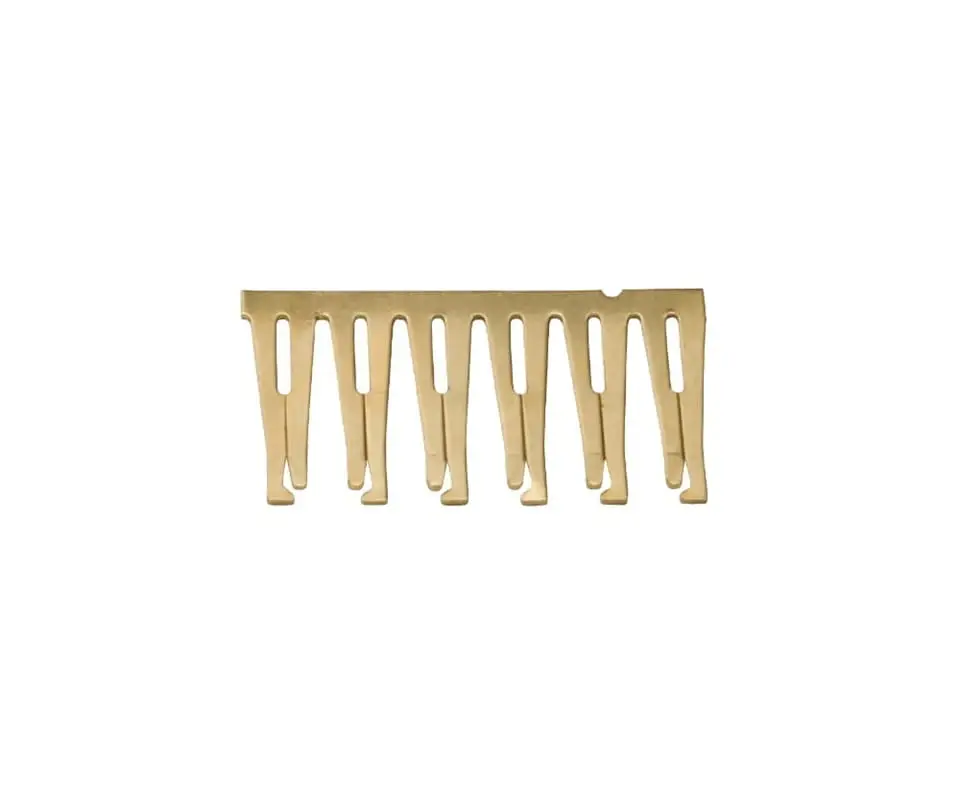
In-die staking embeds a stainless steel spring clip or secondary component into the terminal body —eliminating a separate assembly station and its associated labor cost. These integrated operations are particularly valuable for custom metal terminals destined for sealed automotive connectors where the part count reduction directly simplifies the connector housing design.
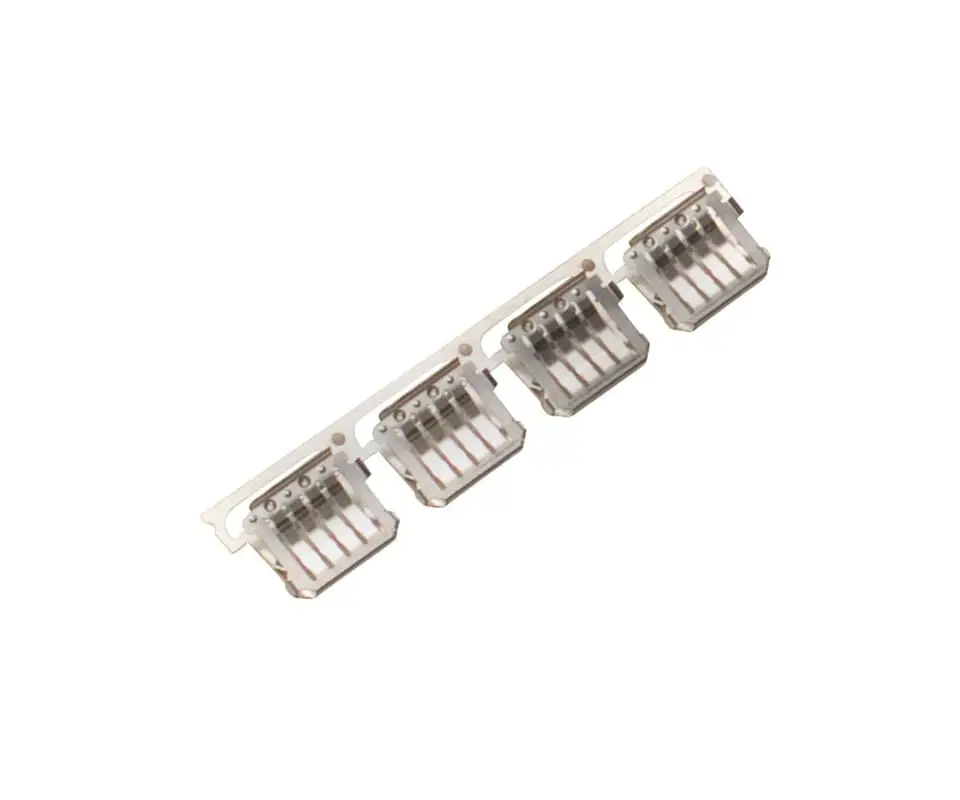
Kravzik‘s in-house progressive die tooling capability enables this level of integration. A recent automotive BMS terminal program combined piercing, coining, forming, and in-die staking of a secondary stainless steel spring within a single 28-station progressive die —delivering a finished assembly-ready terminal at the press exit with zero downstream manual assembly steps.
Tolerance Control and SPC Integration
Progressive dies deliver tighter tolerance control because all forming operations reference a common pilot hole system that maintains registration from station to station. Each station advances the strip by one pitch, and the pilot pins engage before the press ram descends, correcting any feed error before forming begins. This architecture supports Cpk ≥1.67 on critical-to-function dimensions at production speeds —a capability that matters directly for stamped electrical connectors where contact beam width and lance height must remain within ±0.03 mm across millions of strokes.

Multi-slide tolerance control is inherently looser because each slide operates on an independent timing cam. Slide-to-slide timing variation of 1 to 3 milliseconds translates to 0.02 to 0.05 mm of positional uncertainty at the workpiece —acceptable for spring clips and shield contacts but problematic for precision contact beams where normal force depends on sub-0.05 mm dimensional control. [Verdict]: If your terminal requires Cpk ≥1.33 on contact beam dimensions and annual volume exceeds 50,000 units, choose progressive die stamping.
💡 Die Cost Projection: let Kravzik‘s tooling team model your terminal geometry against progressive die station count, cam-actuated station requirements, and per-part amortization —returning a tooling cost estimate within 3 business days.
When Multi-Slide Forming Wins
Complex 3D Spring Geometries
Multi-slide forming claims its territory when terminal geometry bends across multiple planes in a single part. Socket contacts, battery compression springs, EMI shield clips, and multi-plane retention features —these geometries require bends in two to four directions that a single-axis progressive die can only produce through cam-actuated forming stations. Each cam station adds $3,000 to $8,000 to the die cost and consumes one to two additional die stations, increasing total die length and the press tonnage requirement.
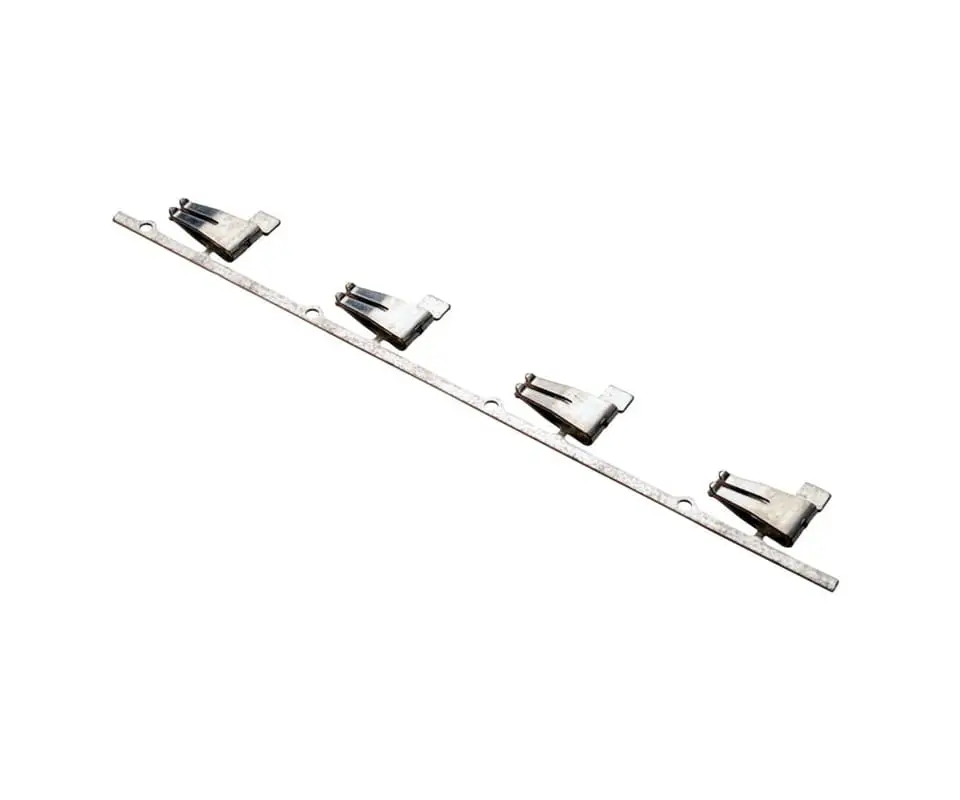
A four-slide machine produces these same bends simultaneously from four directions in a single cycle —no cam stations, no die length penalty, no additional press stroke time.
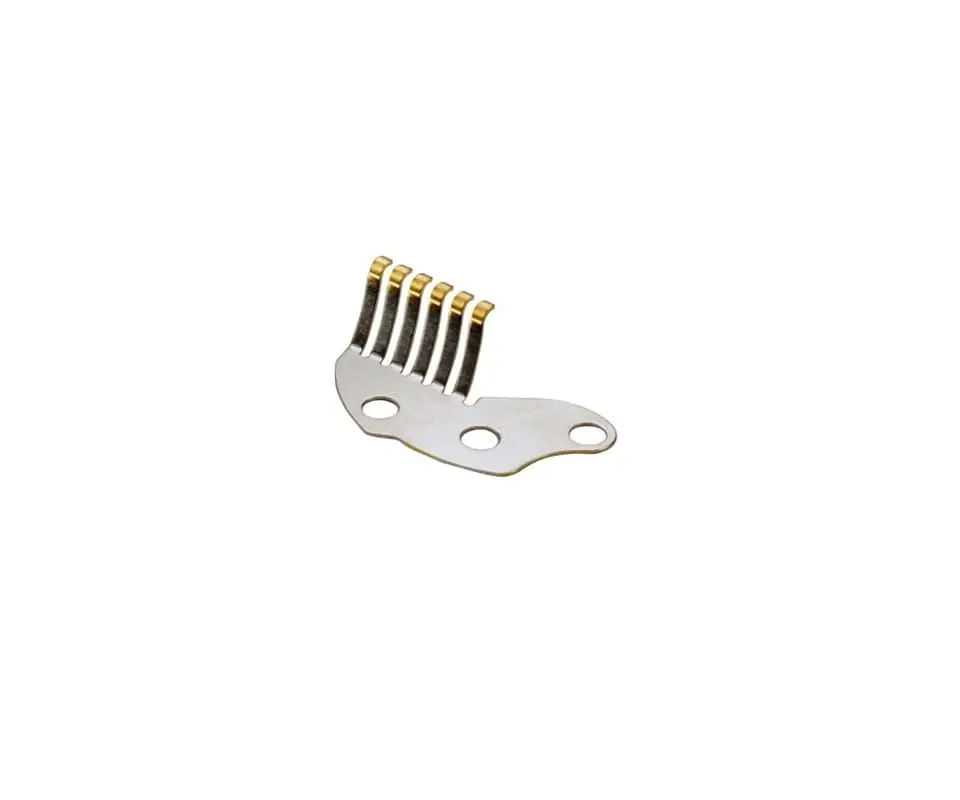
For electrical stamping components with five or more bends distributed across three planes, multi-slide forming delivers a lower per-part cost at virtually any volume because it eliminates the progressive die‘s geometry penalty. The machine itself is simpler —a multi-slide former costs $40,000 to $120,000 versus $100,000 to $400,000 for a high-speed stamping press —and the tooling is less expensive because the slide tools are individual forming elements rather than an integrated die set. Kravzik‘s multi-slide capability extends to spring contacts and battery terminals with up to eight independent bends formed in a single machine cycle.
Prototyping and Bridge Production
Tooling lead time is multi-slide’s decisive advantage for time-sensitive programs. Multi-slide tooling —individual forming slides, cutoffs, and cam profiles —fabricates and validates in 2 to 3 weeks. A full progressive die requires 4 to 8 weeks for design, wire EDM cutting, assembly, and tryout.
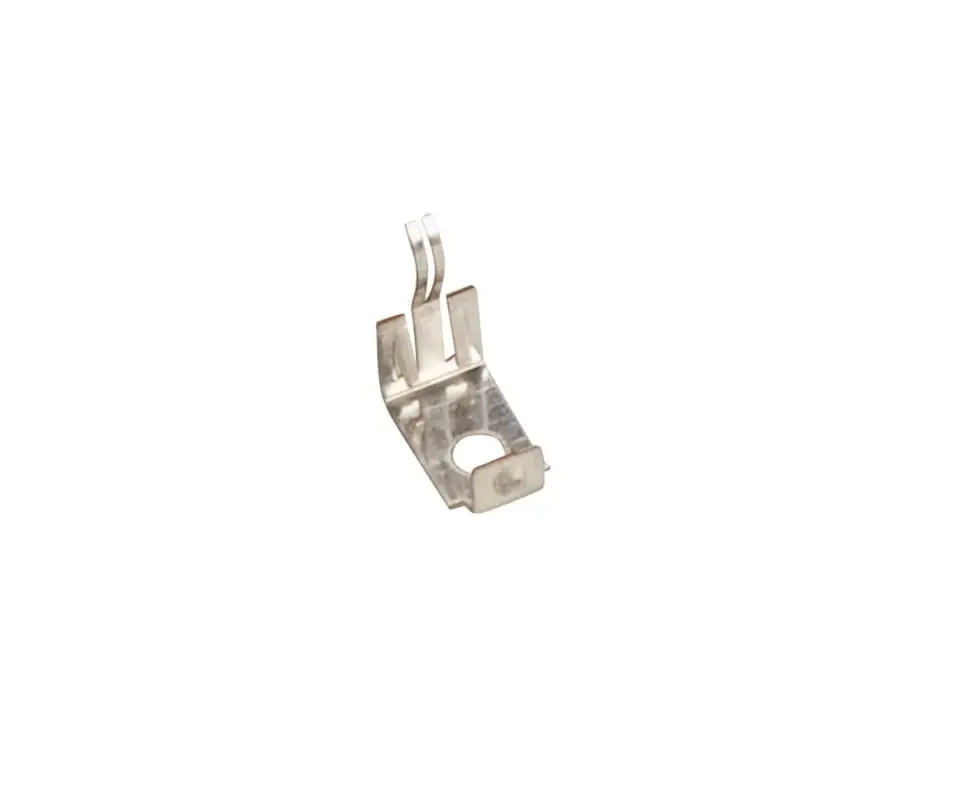
When a program timeline compresses or when a field failure demands an emergency bridge production run while the permanent progressive die is being built, multi-slide’s 2-week tooling turnaround becomes the deciding factor for stamped electrical terminals that cannot wait for hard tooling.
This capability also makes multi-slide the preferred platform for design iteration. A terminal geometry undergoing three to five revisions before finalizing for high-volume progressive die production incurs prohibitive tooling modification costs if each revision requires die rework. Multi-slide tooling costs $500 to $2,000 per modification —one-tenth the cost of modifying a hardened progressive die insert —enabling rapid design iteration for electrical component metal stamping programs where the connector interface geometry is still evolving.
Material Efficiency for Narrow Parts
Multi-slide forming often processes material from wire stock or narrow strip fed directly into the forming zone, eliminating the wide carrier strip required by progressive dies. For narrow terminals —under 3 mm wide —this feed method pushes material utilization above 90%, compared to 70% to 85% for a progressive die that requires a carrier strip wide enough to support pilot holes and skeleton structure. The material savings compound in copper alloy applications where raw material cost exceeds $8 per pound, making multi-slide economically competitive even at volumes where progressive die throughput would otherwise dominate.
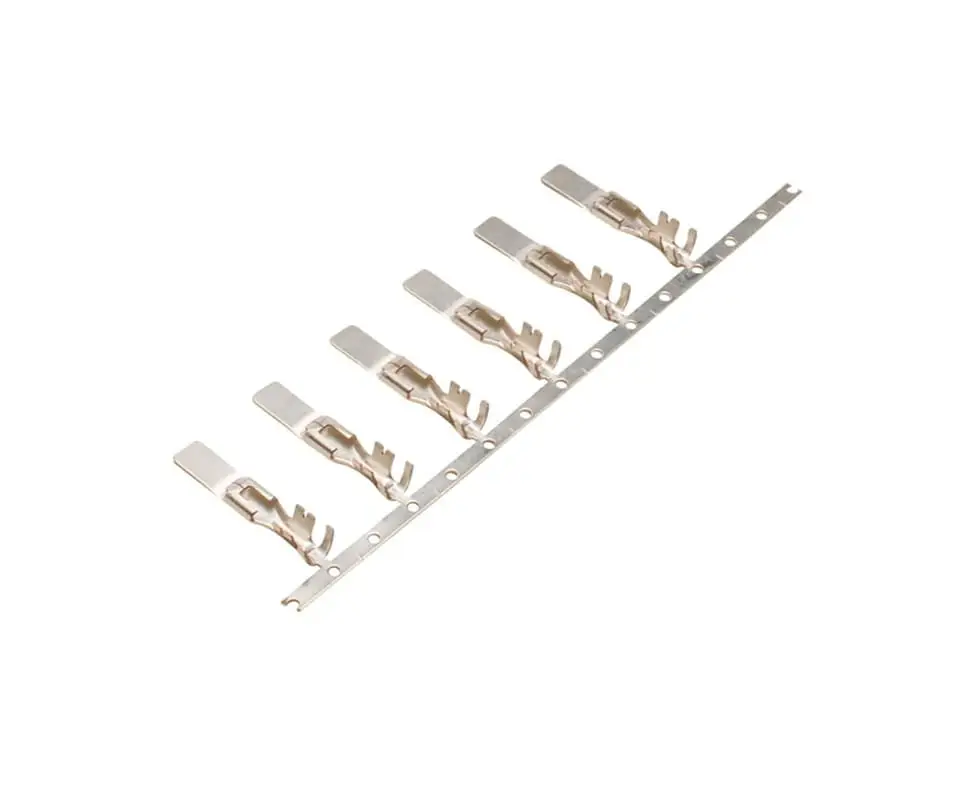
[Verdict]: If your terminal requires bends across three or more planes, or if annual volume is below 15,000 units and geometry complexity is moderate, choose multi-slide forming.
Hidden Trade-offs & Engineering Limits
Plating Logistics and Surface Preparation
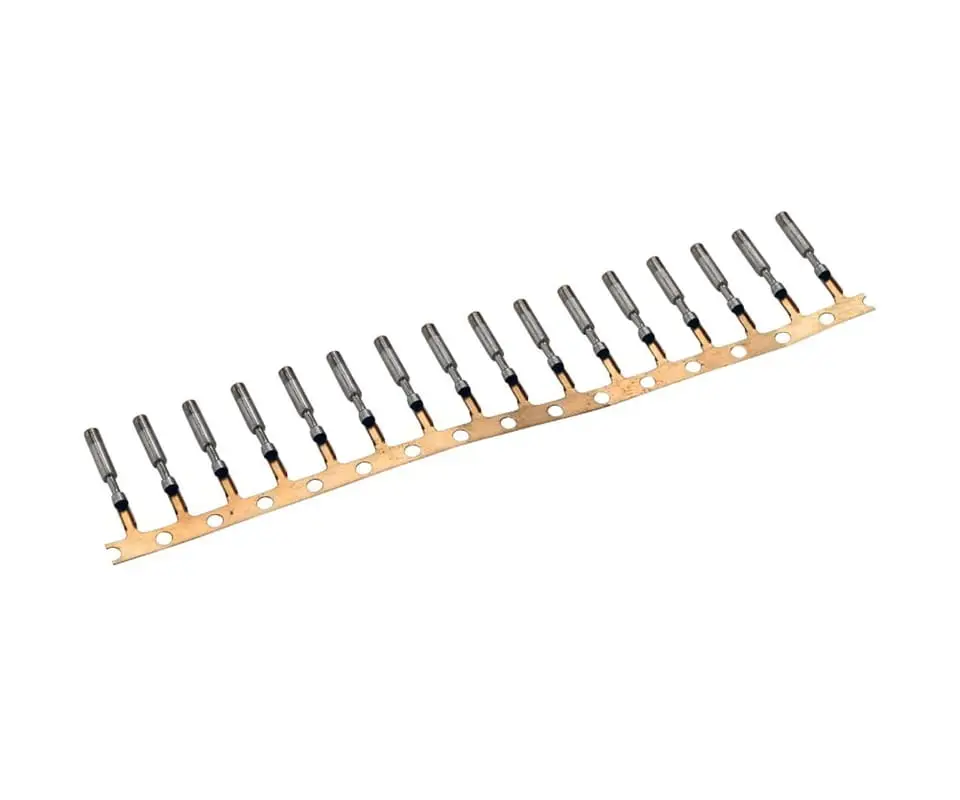
Progressive die stamping leaves terminals attached to their carrier strip —a continuous web that feeds directly into reel-to-reel selective plating lines. This integrated workflow eliminates part handling between stamping and plating, preserves surface cleanliness, and enables selective precious metal deposition on the contact zone alone. Multi-slide forming produces loose, individual terminals that must be bulk-plated in barrels or racks —a process that plates every surface, wastes precious metal on non-functional areas, and introduces part-to-part contact that can create plating thickness variation across the batch.
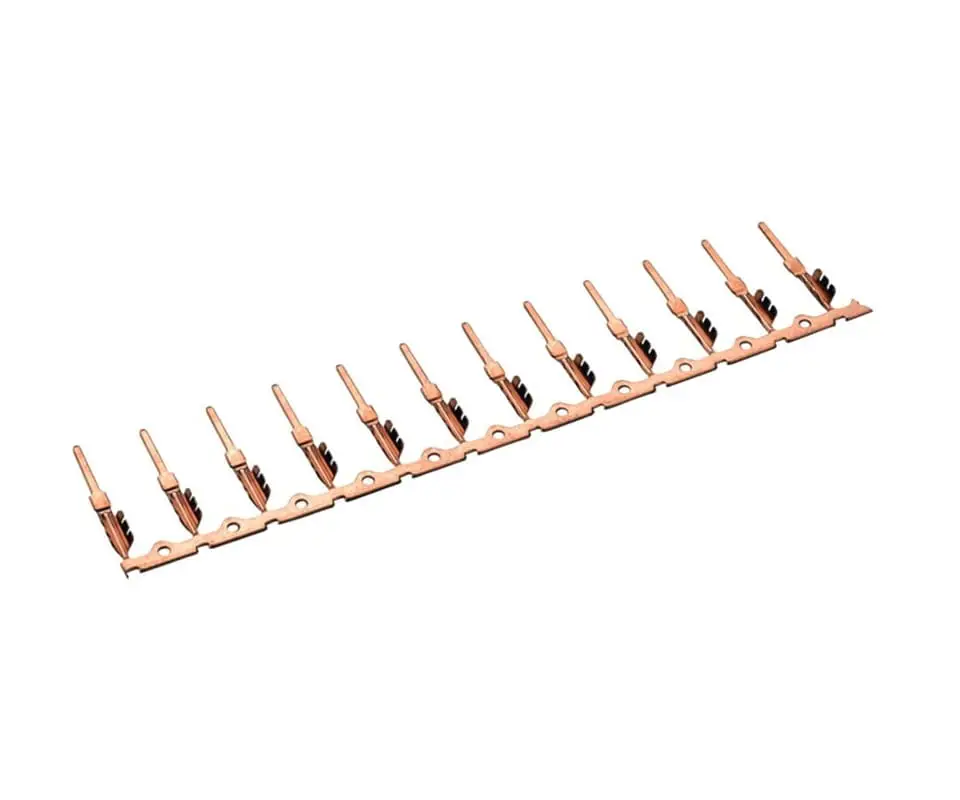
For terminals requiring selective gold or silver plating on the contact beam, the plating cost differential alone can swing the total-cost-of-ownership calculation by $0.005 to $0.015 per part in favor of progressive die stamping with integrated reel-to-reel tin plating or precious metal plating lines. Kravzik operates full in-house plating lines adjacent to the press floor, accepting terminals directly from progressive die presses without intermediate cleaning or handling steps —a closed-loop process that eliminates the 3-to-5-day transit and queue time that outsourced plating introduces for multi-slide parts.
Die Maintenance and Production Scheduling
A progressive die requires punch and insert sharpening every 500,000 to 1 million strokes at $500 to $2,000 per event, removing the press from production for 4 to 8 hours. Multi-slide tooling —individual forming elements subject to lower impact forces than progressive die punches —typically runs 2 to 5 million cycles between maintenance events, and individual slide tools can be swapped in under 30 minutes without removing the entire tooling setup. This distributed maintenance pattern means multi-slide production can absorb tooling changes during short breaks, while progressive die maintenance demands planned half-shift outages that require careful production scheduling.
For electrical stamping programs with just-in-time delivery requirements and minimal buffer inventory, multi-slide’s more forgiving maintenance rhythm can reduce the safety stock overhead needed to cover planned press downtime. Kravzik schedules progressive die maintenance during pre-planned windows and maintains spare insert sets for critical stations, keeping unplanned press stops below 2% of total operating hours for metal stamped components in active production.
Material Thickness and Alloy Constraints
Multi-slide forming operates efficiently on material up to approximately 1.0 mm thickness —beyond that, the slide force required to form heavy-gauge strip exceeds the machine’s frame rigidity, and springback compensation becomes difficult to control across four independent axes. Progressive dies handle material up to 3.0 mm through brute press tonnage. Kravzik‘s 400-ton Bruderer presses routinely stamp stamped electrical terminals in 1.2 mm copper alloy strip for high-current power distribution applications.
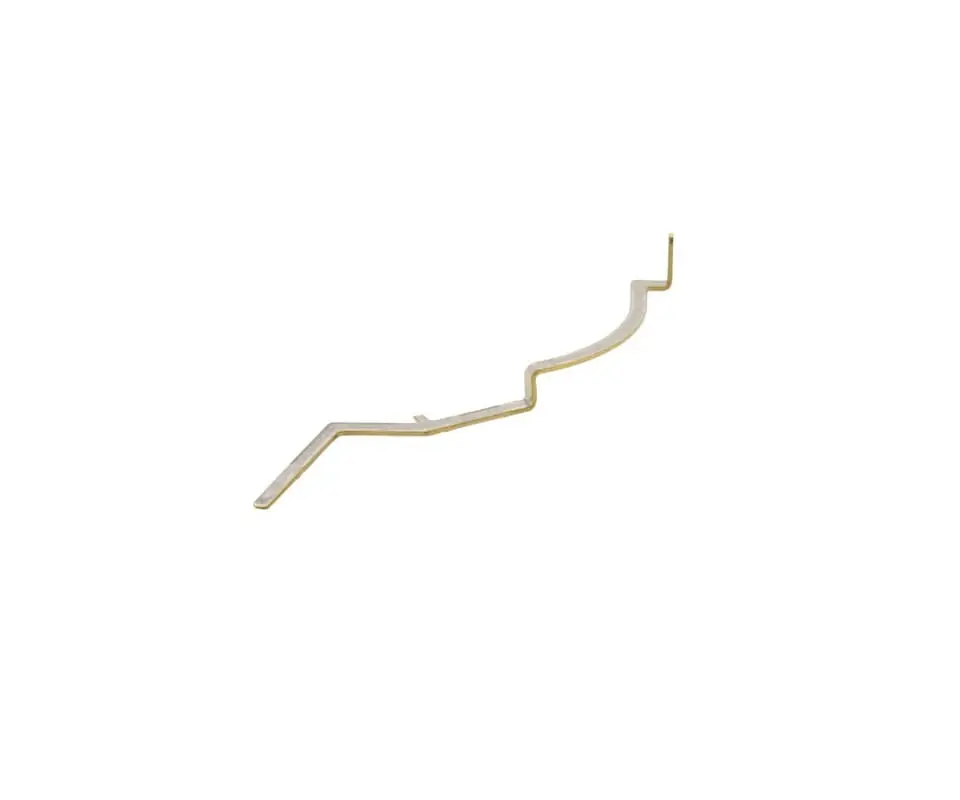
If your terminal requires material thicker than 1.0 mm, progressive die is the only viable option regardless of geometry complexity.
Alloy work-hardening behavior also tilts the decision. High-strength copper alloys like C17200 beryllium copper and C70250 Cu-Ni-Si gain significant tensile strength through the cold-working that occurs during progressive die forming —a beneficial effect that multi-slide’s lower forming forces do not exploit to the same degree. For terminals requiring maximum spring force from a given cross-section, progressive die stamping with controlled work-hardening produces a measurably stronger contact beam than multi-slide forming of the same alloy at the same starting temper.
Critical Risk: Assuming progressive die is always the lowest-cost option for high-volume programs ignores the geometry penalty. A terminal with five bends across three planes stamped on a progressive die with three cam stations can cost 40% more per part than the same terminal formed on a multi-slide —at any volume. Always request a process-specific quote when geometry exceeds two bend planes.
💡 Dual-Path Comparison: request a side-by-side progressive die versus multi-slide cost model with tooling lead time, per-part economics, and throughput analysis for your specific terminal geometry.
The Final Call
Defaulting complex terminal bends to progressive die tooling because of process inertia adds cam-actuated station costs that multi-slide forming eliminates. Kravzik operates both Bruderer progressive die presses and multi-slide machines under one roof, evaluating your terminal against both process paths with transparent cost data.
Send your terminal print for a dual-path progressive die versus multi-slide cost comparison with tooling amortization, per-part economics, and throughput analysis returned within 3 business days.