A quality manager signs off on barrel-plated gold terminals because the plating house quotes $0.06 per part and selective reel-to-reel requires a $4,000 tooling charge — twelve months later, XRF audit data shows gold thickness varying from 0.25 µm to 0.95 µm across the same batch, and 15% of terminals fail contact resistance after 100 insertion cycles. Selective reel-to-reel plating would have held ±0.1 µm on every terminal and saved $440 of gold on non-functional surfaces per 10,000-piece reel.
This comparison breaks down the cost per part, thickness control, functional plating zones, and process logistics that determine whether selective reel-to-reel plating or overall barrel plating fits your stamped electrical terminals.
Read on for the full comparison.
When Selective Reel-to-Reel Plating Wins
Thickness Control for Contact Resistance
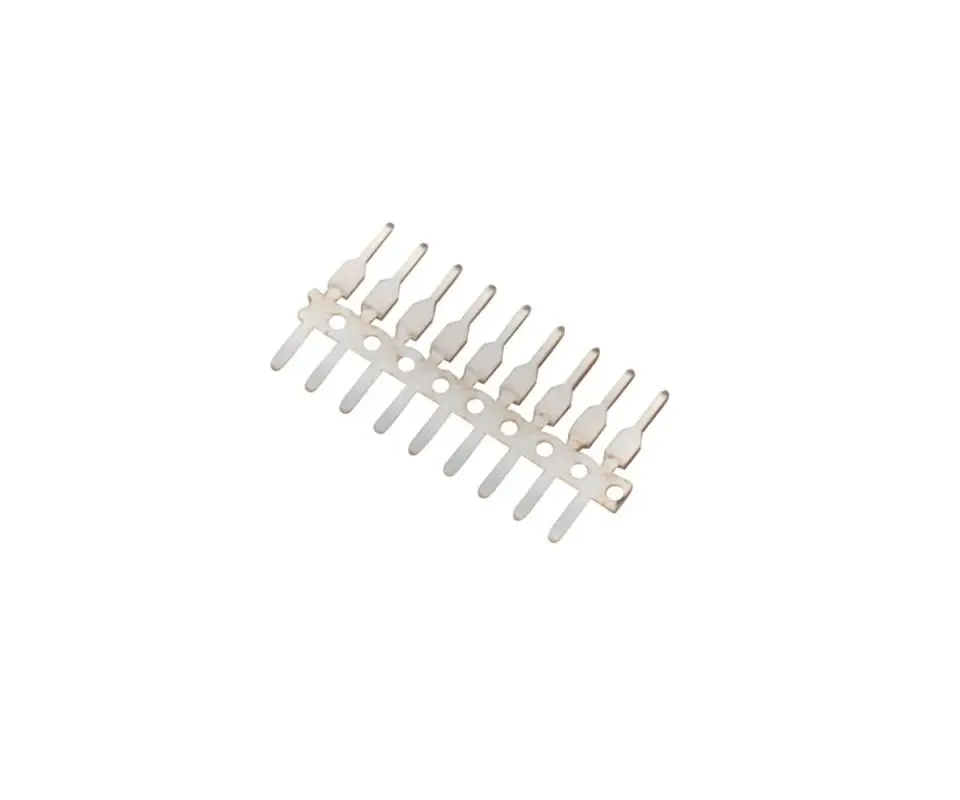
Selective plating delivers tighter thickness control than barrel plating because the current density at the exposed contact zone is uniform and predictable. The mask belt covers all non-target areas, forcing the plating current to concentrate on the exposed contact surface. A carefully designed mask geometry produces a deposition thickness of 0.75 µm ±0.1 µm across every terminal on the reel —a level of control that barrel plating cannot match because parts in a barrel contact each other randomly, creating localized current density variations that produce 0.50 to 1.00 µm thickness variation across parts in the same batch.
This thickness control translates directly to contact resistance consistency. A gold-plated contact with 0.50 µm of gold at the thinnest point may show 2.5 mΩ contact resistance at 100 gf normal force, while the same terminal with 0.75 µm shows 1.8 mΩ. In a 40-position connector where contact resistance must stay below 20 mΩ for signal integrity, a single terminal at 2.5 mΩ paired with others at 1.8 mΩ creates a 0.7 mΩ differential that can cause signal reflection in high-speed data connectors.
Selective plating’s uniform deposition eliminates this variability for stamped electrical contacts in precision interconnect applications.
Process Integration and Surface Cleanliness
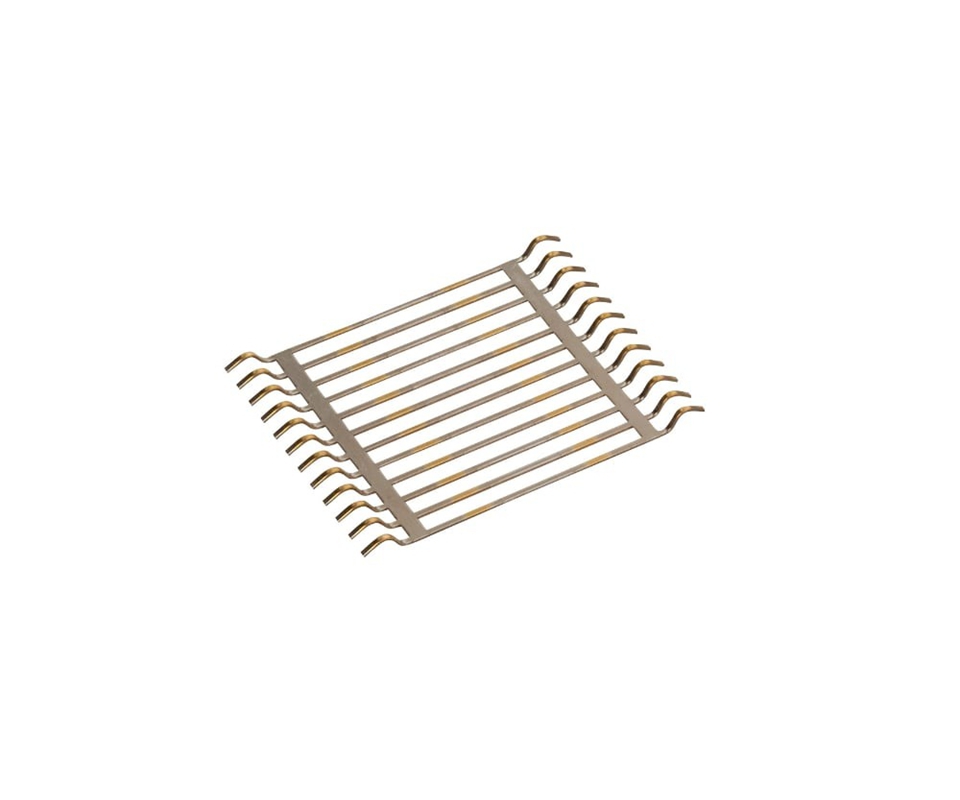
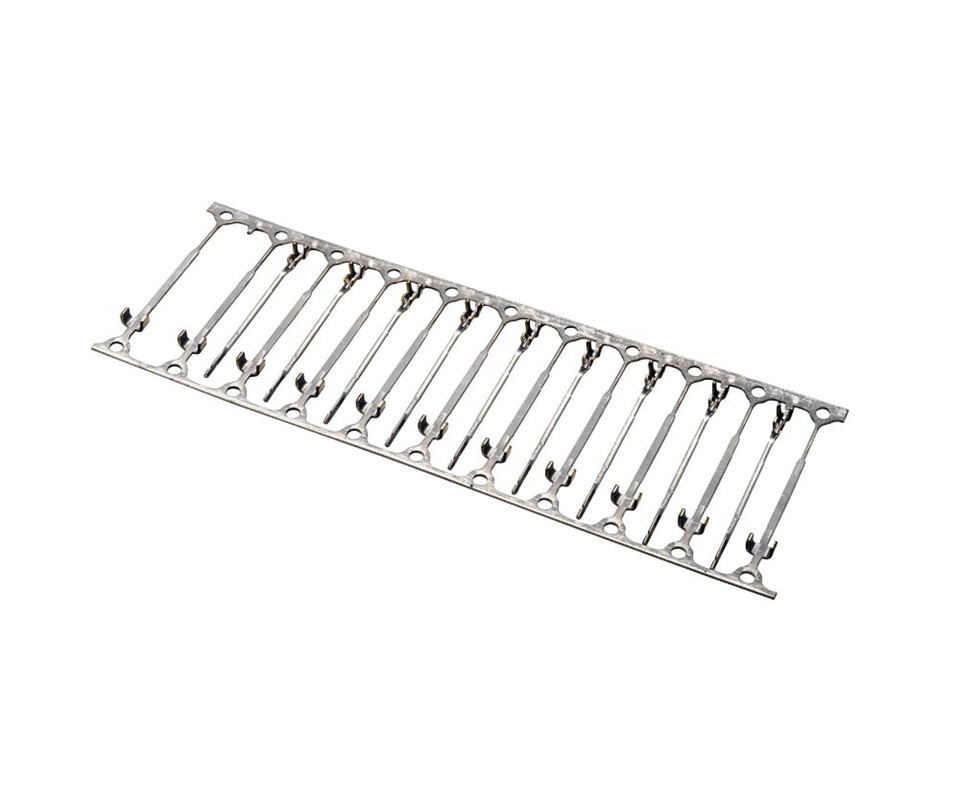
Selective reel-to-reel plating chains directly from the progressive die carrier strip with zero part handling between forming and plating. The terminals stay indexed on their carrier strip —the same pilot holes that positioned the strip through progressive die stations guide it through the degreasing, nickel underplate, and precious metal deposition cells. This continuous-process architecture eliminates the surface contamination risk that barrel plating introduces when terminals are singulated, bulk-transported, and handled between stamping and plating operations.
Surface cleanliness directly affects wire bond pull strength and solderability for electrical component metal stamping terminals destined for semiconductor packaging. A fingerprint or ambient contamination on the terminal surface —introduced during the singulation and barrel-loading step —reduces wire bond pull strength by 15–30% and can cause solder dewetting at the reflow station. Selective plating’s closed-loop process from press to plating preserves the as-stamped surface chemistry and eliminates this contamination vector.
Kravzik’s in-house plating lines accept terminals directly from progressive die presses within the same facility for electrical stamping production runs where surface cleanliness is a functional requirement, not just a cosmetic preference.
[Verdict]: If your annual production volume exceeds 50,000 units and your terminal requires precious metal plating on specific functional zones, choose selective reel-to-reel plating.
When Overall Plating Wins
Low-Volume and Prototype Economics
Overall barrel plating wins the economics argument when annual volume stays below 10,000 units. At this scale, the $5,000 selective plating mask amortizes to $0.50 per terminal in year one —more than the precious metal value of the gold being deposited. Barrel plating the same 10,000 terminals wastes $400 to $600 in gold —but wastes zero dollars on mask tooling.
The breakeven point, accounting for mask amortization, scrap metal value, and handling cost, sits at approximately 10,000 to 15,000 annual units for a typical gold-plated stamped electrical terminal.
This low-volume advantage extends to design iteration programs. A terminal geometry undergoing three contact zone revisions during connector development would require three mask belt modifications at $1,500 to $3,000 each for selective plating —$4,500 to $9,000 in cumulative mask cost. Barrel plating the same three design iterations incurs zero mask cost and wastes $1,200 to $1,800 in excess gold across all iterations.
For electrical stamping programs in the prototype phase where the contact interface geometry is still in flux, barrel plating‘s zero-mask-tooling characteristic is the economically rational choice.
Full-Surface Corrosion Protection
Overall plating deposits metal on every surface —including the retention lance edges, the housing insertion body, and the wire crimp barrel interior. These surfaces do not carry current, but they do contact the connector housing material and are exposed to the operating environment. In under-hood automotive applications where the connector is exposed to humidity, salt spray, and engine compartment chemicals, bare copper alloy surfaces develop corrosion products that can migrate to the contact zone through capillary action along the terminal body.

A tin-plated terminal with overall plating has zero exposed copper —the tin layer covers every surface and provides cathodic protection across the entire part. A selectively tin-plated terminal leaves 70–80% of the surface area as bare copper alloy, relying on the copper’s native corrosion resistance rather than a sacrificial coating. For stamped electrical terminals deployed in harsh environments —engine compartment connectors, marine electrical systems, outdoor telecom enclosures —overall tin plating provides a corrosion protection benefit that selective plating‘s precious metal savings cannot offset.
The cost of a corrosion-induced field failure in a sealed automotive ECU connector dwarfs the $0.02 per terminal in additional tin cost from overall tin plating for bronze terminal stamping in high-reliability applications.
Mixed-Part Plating Batches
Barrel plating accepts mixed terminal geometries in a single batch. Ten different terminal part numbers —each with different contact zone geometry, different overall dimensions, different strip thickness —can be barrel-plated together in one 30-minute cycle. Selective plating requires a dedicated mask belt for each terminal geometry.
A program producing 15 different terminal variants at 2,000 pieces each per year would require 15 mask belts at a combined tooling cost of $75,000 to $120,000. An investment that selective plating‘s precious metal savings cannot recoup at those volumes.
This mixed-batch capability makes barrel plating the preferred finishing method for custom metal terminals in low-volume, high-mix programs. A connector manufacturer producing 50 different connector families each requiring 5 terminal variants at 1,000 to 5,000 pieces per year can barrel-plate the entire annual requirement in 20 plating cycles with zero mask tooling investment. Selective plating the same program would require 250 dedicated mask belts —a tooling investment exceeding $1 million that no precious metal savings calculation can justify for electrical stamping manufacturers serving diverse, low-volume end markets.
[Verdict]: If your annual program volume is below 10,000 units, your terminal requires full-surface corrosion protection for harsh environments, or your program includes more than 10 different terminal geometries, choose overall barrel plating.
Hidden Trade-offs & Engineering Limits
The Nickel Underplate Dependency
Both selective and overall precious metal plating require a nickel underplate —a diffusion barrier that prevents the copper alloy substrate from migrating into the gold or silver top layer and forming brittle intermetallic compounds at the contact surface. Selective plating deposits the nickel underplate on the same exposed zones as the precious metal, leaving 70–80% of the terminal surface as bare copper. Overall plating deposits nickel across the entire terminal body, providing full-surface corrosion protection for the base copper alloy.

The nickel underplate is the hidden cost equalizer. A selectively plated terminal with 2.0 µm of nickel under the gold contact zone costs $0.003 in nickel. An overall-plated terminal with 2.0 µm of nickel across the entire part surface costs $0.008 in nickel —narrowing the precious metal cost advantage.
For stamped electrical contacts where the underplate thickness and coverage are specified by the end customer’s plating specification, the nickel underplate cost increment can reduce selective plating‘s total precious metal savings from 60% to 40% —still substantial but worth modeling for each terminal geometry before committing to a mask belt investment.
Barrel Plating Damage and Part Geometry Limits
Barrel plating subjects loose terminals to tumbling contact with each other and with the barrel wall. Thin contact beams —below 0.15 mm thickness at the free end —can bend, tangle, or interlock during barrel rotation. A batch of 10,000 terminals with 0.12 mm contact beams will produce 50 to 200 mechanically damaged parts per barrel cycle, representing a 0.5–2.0% defect rate that must be sorted out by 100% visual inspection or automated optical sorting.
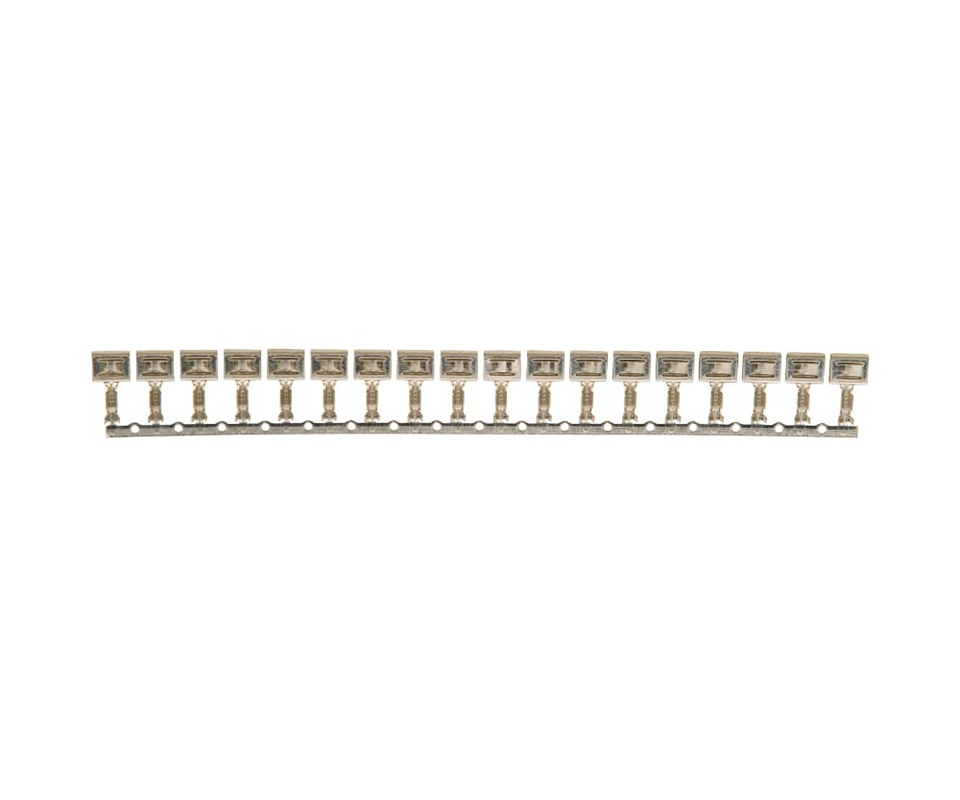
Selective reel-to-reel introduces zero mechanical stress —the terminals remain indexed on the carrier strip throughout the plating process with the same positional registration they had in the progressive die.
This damage susceptibility creates a geometry constraint for barrel plating. Terminals with contact beam thickness below 0.20 mm, with sharp lance features, or with aspect ratios above 8:1 tend to entangle in the barrel. Selective plating processes these geometries without damage because the terminals never separate from their carrier strip.
For electrical stamping parts with delicate spring contact geometries, the process choice is often dictated by the terminal’s mechanical robustness rather than plating economics —selective plating is the only option for terminals that cannot survive barrel tumbling without damage.
Post-Plating Operations and Strip Architecture
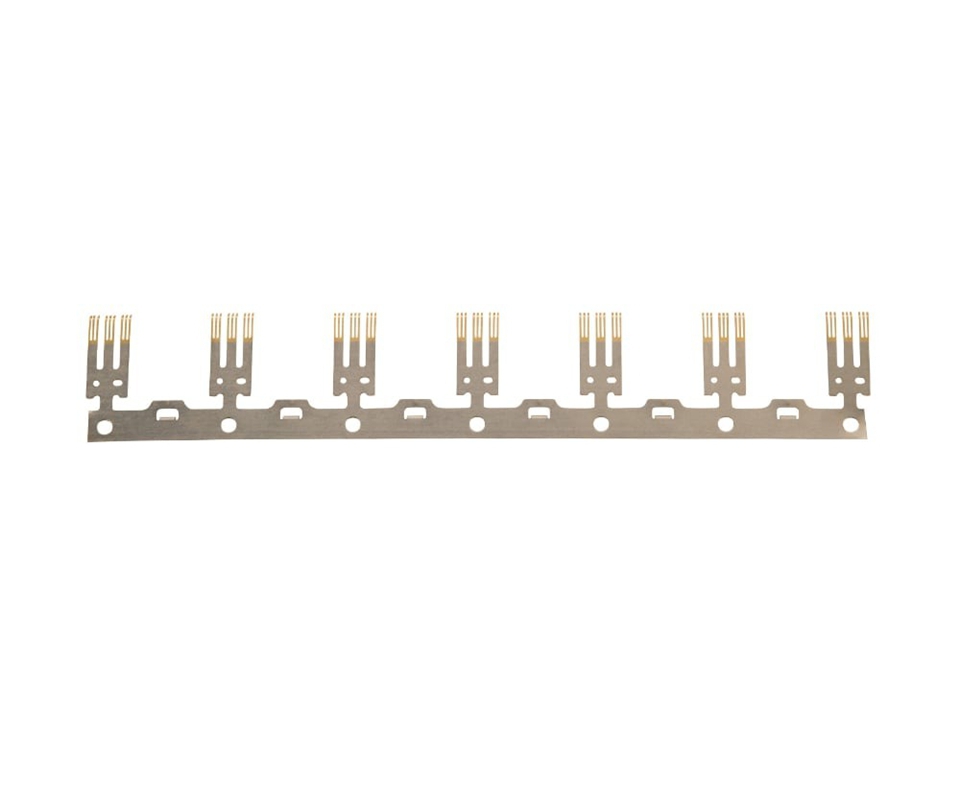
Selective plating leaves the terminal attached to its carrier strip after plating —the same carrier strip that will feed into the customer’s automated terminal insertion equipment. This architecture enables downstream integration. The reel of selectively plated terminals can be fed directly into a connector assembly machine that cuts each terminal from the carrier strip and inserts it into the housing in a single continuous operation.
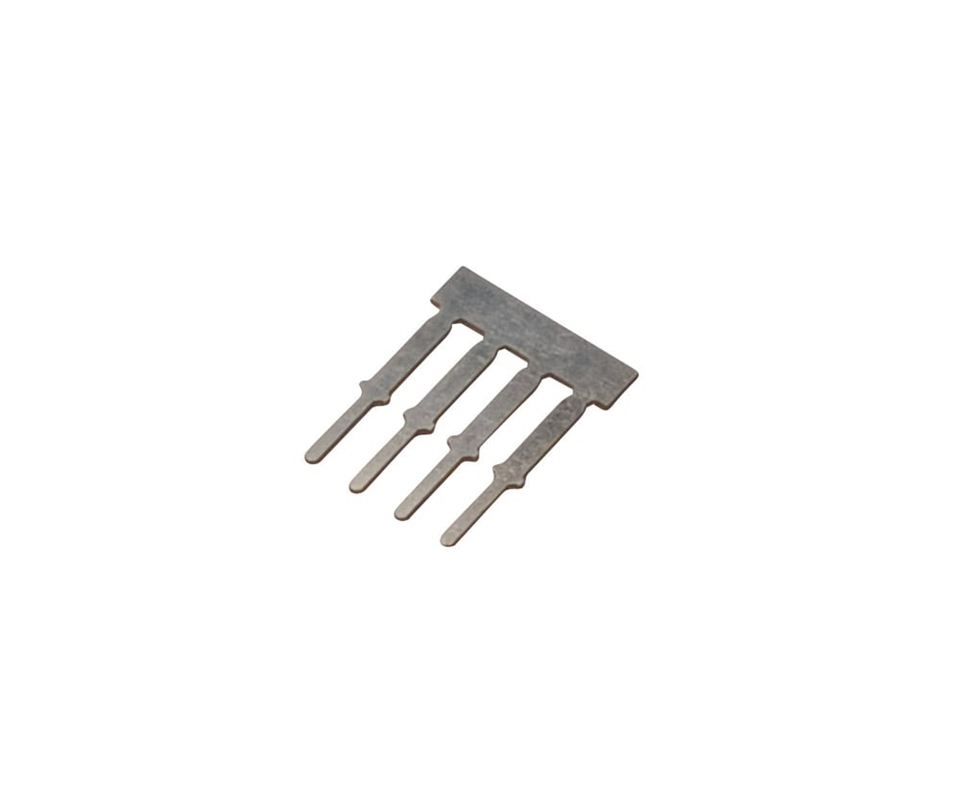
Overall-plated terminals are loose pieces that must be bowl-fed or tray-loaded into the assembly machine —a slower and more complex feeding process.
This downstream integration advantage makes selective plating the default choice for high-volume connector assembly programs regardless of the precious metal economics. A connector assembly line running at 60 cycles per minute processes 3,600 terminals per hour with reel-fed selective-plated strip versus 2,000 to 2,500 per hour with bowl-fed overall-plated parts —a 30–40% assembly throughput penalty that alone justifies the selective plating mask investment. Kravzik‘s strip architecture preserves the carrier strip through stamping, plating, and delivery for electrical stamping connectors destined for automated high-speed assembly lines where reel-to-reel terminal feeding is a production requirement.
Critical Risk: Selecting overall barrel plating for a terminal that feeds into an automated insertion machine reduces assembly throughput by 30–40% compared to reel-fed selective-plated strip. The $0.04 per-terminal precious metal savings from selective plating are secondary —the assembly line throughput loss from bowl-feeding loose parts costs $0.08 to $0.15 per terminal in labor and machine time.
💡 Plating Cost Model: send us your terminal print with plating specification and annual volume for a comparative cost model covering selective versus overall plating, including precious metal consumption, mask amortization, and downstream assembly impact.
The Final Call
Barrel plating terminals at production volume wastes precious metal and introduces mechanical damage that selective reel-to-reel plating eliminates. Kravzik operates both plating methods in-house and evaluates your terminal on total cost per reel, including mask amortization, defect rate, and corrosion protection requirements.
Share your terminal plating drawing for a selective-versus-overall plating cost analysis with precious metal budget, mask investment, and return-on-tooling timeline, returned within 3 business days.